










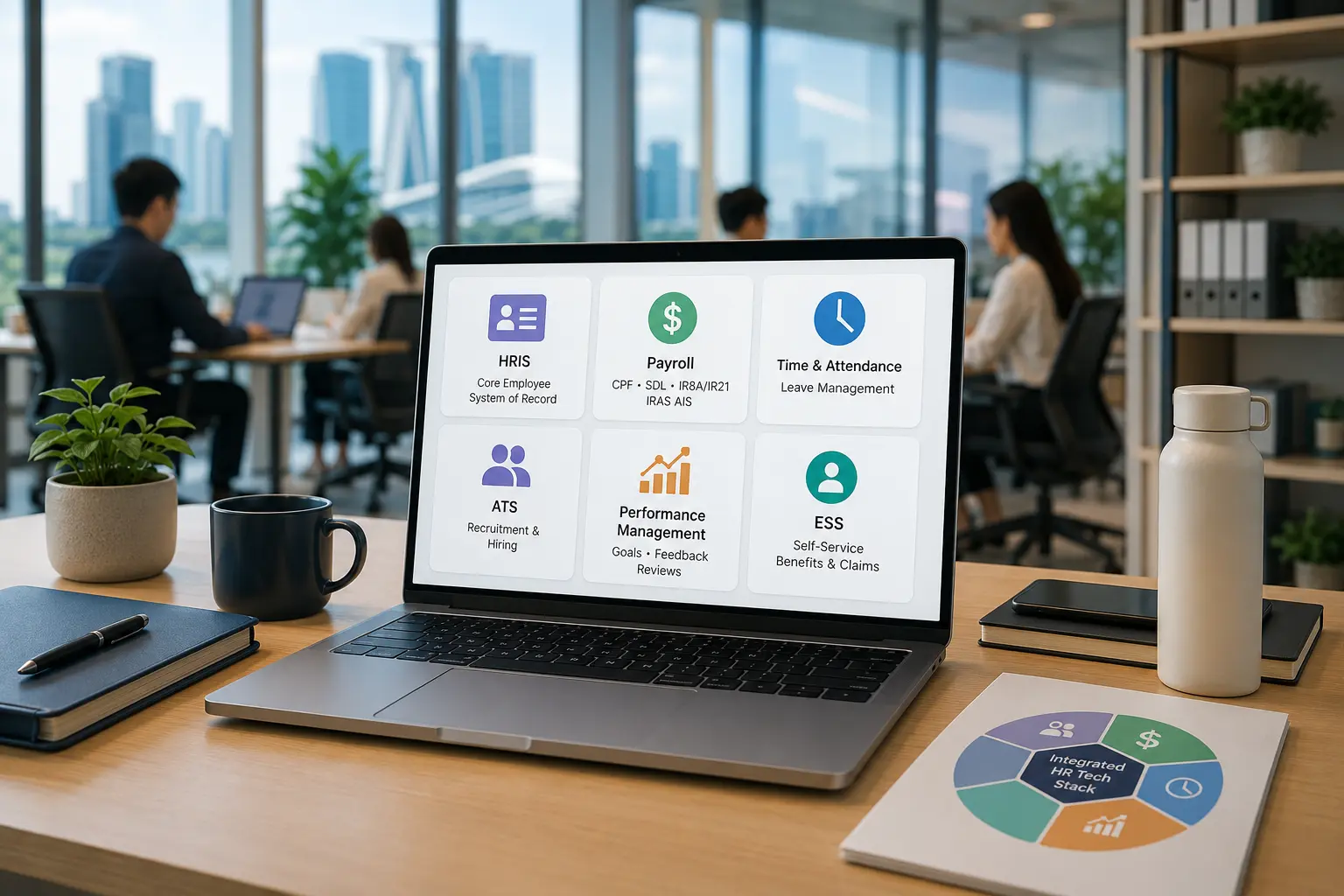

A 200-person company in Singapore typically needs six systems working together: a Human Resource Information System (HRIS), payroll software Singapore compliant with CPF and IRAS, time and attendance tracking, an Applicant Tracking System (ATS), a performance management system, and Employee Self-Service (ESS) for benefits and claims.
Fewer than that, and HR spends its time reconciling spreadsheets instead of running the business.
The average mid-market HR team runs far more tools than it needs, often more than a dozen overlapping platforms. At 200 employees, the fix is not more software. It is exactly these six pieces, integrated.
1. HRIS (Core Employee System of Record)
A Human Resource Information System (HRIS) is the single system of record for employee data. Without one, every other system in the stack pulls from a different, slightly outdated version of the truth.
A typical HRIS record covers:
- Employee profiles and org charts.
- Document storage for contracts and letters.
- Full employment history across roles and changes.
A strategic HR management process depends on this system being accurate first, since workforce planning and compliance reporting both pull from the same employee record. Companies still running HR off spreadsheets past 150 employees typically spend far more admin time on basic record updates, and that time compounds every time a new hire or role change happens.
2. Payroll Software (CPF, SDL, IR8A/IR21, IRAS AIS)
Payroll software Singapore compliant needs to handle four things correctly, and it needs to update automatically when rates change.
- CPF contributions are calculated against the current Ordinary Wage ceiling.
- Skills Development Levy (SDL) at 0.25% of the first S$4,500 of monthly wages, minimum S$2 per employee.
- IR8A and IR21 filings for annual income reporting and foreign employee tax clearance.
- IRAS Auto-Inclusion Scheme (AIS) e-filing is mandatory for employers with 5 or more employees.
The CPF Ordinary Wage ceiling rose to S$8,000 from 1 January 2026, up from S$7,400 in 2025. According to Singapore Secretary Services’ 2026 payroll guide, any payroll software Singapore companies have not updated for this ceiling will miscalculate every affected employee’s contribution.
This is where Singapore payroll compliance stops being a manual spreadsheet exercise and becomes a system requirement. Getting this wrong at 200 employees means correcting hundreds of contribution records at once, not a handful.
3. Time and Attendance / Leave Management
Time and attendance software tracks work hours, overtime, and leave balances, and should feed directly into payroll to avoid manual reconciliation every pay cycle.
With 200 employees, manual leave tracking is one of the most common sources of payroll errors, since a missed update on one employee’s balance cascades into the next pay run.
Leave entitlements still need to track against Singapore employment practices, particularly statutory annual, sick, and parental leave minimums under the Employment Act. A system that does not enforce these minimums automatically puts the compliance burden back on a person checking manually, which is exactly the kind of manual step that breaks down at 200 employees.
4. Applicant Tracking System (ATS)
An Applicant Tracking System (ATS) manages job postings, candidate pipelines, and interview scheduling in one place instead of email threads and spreadsheets.
With 200 employees, hiring volume alone makes manual tracking unreliable, and Fair Consideration Framework advertising requirements need a clean record trail showing when a role was posted and how candidates were considered.
Companies using RPO services in Singapore to manage hiring volume typically run their ATS as the single source of truth for every requisition, from job ad to offer letter.
5. Performance Management System
A performance management system replaces annual, spreadsheet-driven reviews with structured, ongoing tracking of goals and feedback.
With 200 employees, informal, manager-memory-based performance tracking becomes inconsistent and difficult to defend in a promotion, reward, or termination dispute, particularly once the Workplace Fairness Act raises the bar on documented, objective criteria.
A dedicated talent management strategy needs this data to make defensible decisions on promotions, retention, and reward, not just an annual form nobody revisits until the next cycle.
6. Employee Self-Service (ESS) and Benefits/Claims
Employee Self-Service (ESS) lets employees view payslips, apply for leave, and submit claims without going through HR for every request.
With 200 employees, every manual leave or claim request that routes through HR is time HR is not spending on anything strategic.
Businesses using HR outsourcing in Singapore support typically pair ESS with claims and benefits administration so the entire request cycle runs without manual intervention at any step.
What Happens When a Piece of This Stack Fails
A payroll or compliance failure in this stack is not just an inconvenience. It carries real financial and legal consequences, and the cost compounds the longer it goes unnoticed.
- Late CPF contributions: interest accrues at 1.5% per month on the outstanding amount from the day after the due date, with no waiver for a first-time miss.
- Persistent non-payment: the CPF Board can pursue prosecution, with court fines of S$1,000 to S$5,000 per offence for a first conviction, rising to S$2,000 to S$10,000 and up to 12 months’ imprisonment for repeat offences.
- Missed AIS filing deadlines: IRAS can impose a penalty of up to S$5,000 per late return, on top of the administrative cost of correcting hundreds of individual records.
- Undocumented performance or leave decisions: these become difficult to defend in a dispute, particularly once the Workplace Fairness Act formalizes discrimination as a legal claim rather than a culture issue.
CPF Board’s own enforcement and penalties page confirms that non-compliance also affects future work pass applications, since MOM factors CPF compliance history into Employment Pass and S Pass processing.
How Procloz Supports HR Tech Stack Decisions in Singapore
Procloz helps companies map their HR tech stack against actual compliance requirements, from CPF and IRAS filings to Employment Act leave tracking, before recommending or integrating any specific tool. This includes payroll processing support for companies that are not yet ready to run software fully in-house.
Companies building out their HR tech stack work with Procloz to keep every compliance requirement covered while the stack scales.
Six Systems Is the Right Target
These six components cover the full employee lifecycle: HRIS as the source of truth, payroll for compliance, attendance and leave for accuracy, ATS for hiring, performance management for defensible decisions, and ESS for reducing HR’s manual workload.
Buying more tools than this rarely adds capability. It adds integration overhead and licensing cost without solving the reconciliation problems a 200-person company actually has, and it usually means someone on the HR team ends up maintaining a system nobody else uses.
Contact us for assistance now.
Frequently Asked Questions about Payroll Software in Singapore
Q: Why is 200 employees the point where a full HR tech stack becomes necessary?
A: Below roughly 150 to 200 employees, manual spreadsheets and email-based processes are usually still manageable. Past that point, reconciliation errors in payroll, leave, and hiring data increase fast enough to justify integrated software.
Q: Should HRIS and payroll software be one system or two separate ones?
A: Either works, but they must share data automatically. A single integrated platform reduces reconciliation work, while two separate systems require a reliable connection to avoid manual data entry between them.
Q: What compliance features must payroll software in Singapore handle?
A: Payroll software must calculate CPF contributions correctly, apply Skills Development Levy, generate IR8A and IR21 forms, and support IRAS AIS e-filing. It should also update automatically when contribution rates or ceilings change.
Q: Does a 200-person company really need a dedicated ATS?
A: Yes. At this hiring volume, tracking candidates through email or spreadsheets becomes unreliable, and a dedicated ATS is also needed to maintain records for Fair Consideration Framework advertising compliance.
Q: What does Employee Self-Service actually reduce for HR?
A: ESS reduces the volume of manual leave, payslips, and claims requests that would otherwise route through HR staff directly. Procloz typically pairs ESS with claims processing, so most routine requests need no manual intervention.