












Last updated: May 2026
An Employer of Record (EOR) allows businesses to hire full-time employees in any country without setting up a local legal entity, reducing onboarding time by up to 50% and saving USD 20,000 to USD 150,000 in entity setup costs per market (Velocity Global Work Trends Report, 2024).
With 73% of companies successfully growing their global workforce through EOR services (Slasify / Business Research Insights, 2024), EOR has become the default infrastructure for international remote team expansion in 2026.
What Is an Employer of Record and How Does It Work?
An EOR is a third-party organisation that becomes the legal employer of your workers in countries where your company has no local entity. The EOR handles employment contracts, payroll processing, tax withholding, statutory contributions, benefits administration, and termination compliance. Your company manages the employee’s day-to-day work and output.
This is the critical distinction. You control who you hire and what they do. The EOR carries the legal employment obligations in that country.
The EOR market is valued at USD 5.97 billion in 2026 and growing at 6.8% CAGR, projected to reach USD 10.46 billion by 2035 (Business Research Insights / Slasify, 2026). Over 65% of multinational companies have already adopted EOR services to manage compliance and payroll for international hires (Market Growth Reports, 2025).
APAC is the fastest-growing EOR market, expanding at 10% CAGR through 2034 driven primarily by hiring activity in India, Singapore, the Philippines, and Southeast Asia (SSR, 2026).
What Are the Strategic Benefits of Using an EOR for International Remote Teams?
1. Legal Compliance in Every Market Without Building Internal Expertise
Every country your remote team operates in has its own employment law framework, contracts, leave entitlements, termination procedures, statutory contributions, and data protection obligations. Staying compliant across multiple jurisdictions simultaneously requires country-specific legal knowledge that most in-house HR teams do not have and cannot maintain.
EOR providers carry that expertise as a core function. They operate employment systems in each country daily, tracking regulatory changes as they occur. Countries continue updating labour frameworks in 2026: Singapore introduced six CPF-related changes and tighter work pass enforcement; Malaysia launched a new electronic stamp duty system; Indonesia raised provincial minimum wages by 5–7% (Agile HRO, 2026). An EOR absorbs these changes automatically.
Companies that hire international employees through EOR services save 40–60% of administrative costs and eliminate compliance risks that can carry penalties of 10–50% of annual payroll in some jurisdictions (Custom Market Insights, 2026).
The compliance case alone justifies the model for most expanding businesses. Procloz’s in-country expertise spans key APAC and global markets, covering employment law, payroll compliance, and statutory benefit requirements in each.
2. Faster Hiring Days Instead of Months
Setting up a legal entity in a new country takes three to six months in most markets. Entity costs range from USD 20,000 to USD 150,000 depending on the jurisdiction (Employsome, 2026).
This timeline and cost structure make entity-based expansion impractical for early-stage market testing, small headcounts, or companies that need to move on talent before a competitor does.
EOR compresses that to days. The EOR’s entity is already established. The onboarding process runs through an existing compliance infrastructure.
Businesses using EOR models reduce onboarding time by up to 50% and see a 37% increase in new hire productivity within 60 days of joining (Velocity Global, 2024).
88% of top-funded startups, those that have raised USD 100 million or more, go multi-country within 18 months of their first international hire, and most of that expansion runs through EOR infrastructure rather than direct entity setup (Deel State of Global Hiring Report, 2025). Speed is a competitive variable. EOR delivers it.
Procloz’s global EOR services cover entity-free hiring across 100+ countries, with in-country compliance and payroll teams in each key market.
3. Accurate, Compliant Payroll Across Multiple Countries
Managing payroll for an international remote team involves multiple currencies, varying pay cycles, different statutory deduction rates, tax withholding obligations, and country-specific filing deadlines. A single error across any of these dimensions creates financial penalties and damages employee trust.
EOR providers consolidate all of this into a single managed infrastructure. Businesses using EOR-managed payroll platforms saw a 34% reduction in payroll errors and missed filings compared to in-house management (Everest Group, 2023, via Compunnel).
That reduction directly translates into fewer penalty notices, fewer employee payment corrections, and less HR time spent on remediation.
For businesses operating across APAC markets, this matters on a practical level. Superannuation contributions in Australia, CPF in Singapore, PF and ESIC in India, SSS in the Philippines, and KiwiSaver in New Zealand all carry different employer contribution rates, filing frequencies, and penalty structures for late or incorrect submissions.
Procloz’s global payroll services handle payroll execution and statutory filings across all key markets, including outsourced payroll services in Australia, payroll services in Singapore, payroll services in India, payroll services in the Philippines, and payroll services in New Zealand.
4. Contractor Misclassification Risk Eliminated
Many companies enter new markets using contractors faster to onboard, with no statutory benefit obligations, and lower fixed costs. The compliance exposure is significant and growing.
Misclassifying an employee as an independent contractor triggers back taxes, penalties, mandatory benefit back-payments, and in some jurisdictions, forced reinstatement. In the US, a single misclassification finding for a worker bracket in California can cost more than three years of that worker’s payroll (Slasify Account Manager, 2025).
The EU Platform Work Directive, which entered into force in December 2024 and requires transposition into national law by December 2026, establishes a legal presumption of employment for platform workers meeting defined control criteria, raising the stakes for misclassified contractor arrangements across all 27 EU member states.
An EOR resolves this by employing workers directly on compliant contracts from day one. The EOR’s legal team ensures classification is correct under local law before the working relationship begins. More than 38% of global companies already use EOR platforms specifically to onboard contractors and freelancers into compliant employment arrangements (Market Growth Reports, 2025).
Procloz’s contractor management service handles compliant classification, onboarding, and payment across 50+ countries.
5. Scalability Without Fixed Infrastructure Cost
International remote teams grow unevenly. A new market might start with two hires and scale to twenty within 12 months or stall at five. Payroll infrastructure that requires fixed investment to add each market or headcount tier creates a cost drag at exactly the point when the business needs agility.
EOR pricing operates per employee per month, and costs scale directly with headcount, with no sunk cost if hiring plans change. EOR is typically more cost-effective than entity establishment for teams of under 30 employees per market, and provides a clean exit if a market does not perform (Employsome, 2026).
SMEs now account for more than 53% of all EOR clients globally, reflecting this agility advantage (Custom Market Insights, 2026).
Procloz’s workforce advisory and consulting service supports the market entry decision, including entity vs. EOR analysis, cost modelling by country, and headcount threshold planning.
6. Access to Locally Competitive Employee Benefits
International remote employees expect benefits that are competitive in their local market, not a standard package designed for the company’s home country. Health cover, pension contributions, leave entitlements, and additional perks vary significantly across APAC and other markets.
EOR providers administer locally appropriate benefit packages in each market as standard. This includes mandatory statutory benefits, superannuation, CPF, PF, SSS, as well as supplementary benefits benchmarked to local market norms. Employees receive what they expect under local law. The company does not need to research, negotiate, or administer each benefit plan independently.
Procloz’s compensation and benefits advisory service supports benefit benchmarking by market and helps businesses build compensation frameworks that are both locally competitive and internally equitable across a distributed team.
7. Data Security and Cross-Border Privacy Compliance
Payroll and employment data for an international remote team spans multiple data protection regimes simultaneously. Processing this data incorrectly or storing it insecurely creates regulatory exposure in every market where an employee is based.
Purpose-built EOR platforms operate with encrypted portals, role-based access controls, and audit trails that meet the data protection standards of each jurisdiction they serve. Procloz holds ISO 27001 and ISO 9001 certifications. Full details are on the registrations and accreditations page.
For businesses with employees in Australia (Privacy Act 1988), Singapore (PDPA), the Philippines (Data Privacy Act 2012), New Zealand (Privacy Act 2020), India (DPDP Act 2023), or the UK/EU (GDPR), the EOR’s certified infrastructure provides the technical and procedural compliance framework that managing data in-house across these regimes cannot replicate.
EOR vs. Setting Up a Local Entity: Direct Comparison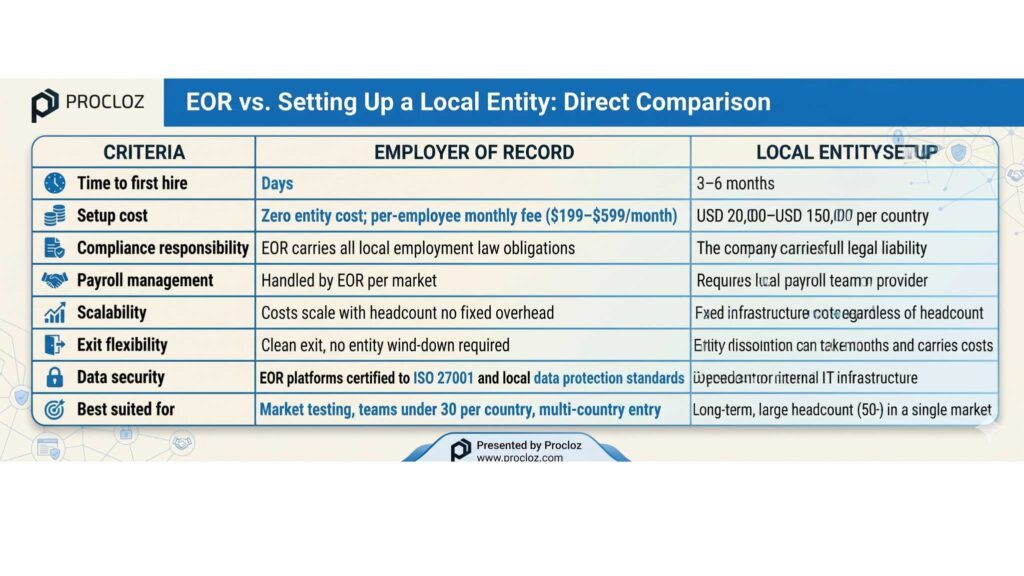
Frequently Asked Questions on Employer of Record for International Remote Teams
What is the difference between an EOR and a PEO?
An Employer of Record (EOR) becomes the legal employer in a country where your company has no entity you do not need an existing legal presence. A Professional Employer Organisation (PEO) co-employs workers alongside your company, but requires you to already have a legal entity in that country.
For international expansion into new markets, EOR is the relevant model. PEO works for companies already established in a jurisdiction that want HR support alongside an existing entity.
How much does an Employer of Record cost?
EOR pricing typically operates on a per-employee, per-month basis ranging from USD 199 to USD 599 depending on the country and scope of services included (SoftwareSuggest, 2026). This compares with entity setup costs of USD 20,000 to USD 150,000 per country, plus ongoing local payroll, legal, and compliance costs. For teams of fewer than 30 employees per market, EOR is consistently more cost-effective than establishing an entity.
Which countries can Procloz support through its EOR service?
Procloz’s global EOR services cover 100+ countries, with dedicated in-country payroll and compliance teams across key APAC markets, including Australia, Singapore, India, the Philippines, and New Zealand, as well as the US, UK, and Canada.
For APAC-specific market entry, Procloz’s in-country expertise covers the full compliance lifecycle from employment contracts and statutory benefits to data protection and termination procedures.