











Last updated: June 2026
Most businesses assume a payroll tax audit is something that happens to other companies. Then an Australian Taxation Office (ATO) letter arrives and that assumption collapses fast.
A payroll audit is not a random inconvenience. It follows a pattern. The ATO targets specific discrepancies, requests specific records, and assesses penalties on specific failures. Understanding what they actually look for is the difference between a clean audit response and a six-figure liability.
What Actually Triggers a Payroll Tax Audit?
ATO payroll compliance reviews are often risk-based and may be prompted by data mismatches, late lodgements, or inconsistent employer reporting.
Since the introduction of Single Touch Payroll (STP) Phase 2, the ATO receives real-time payroll data every pay cycle. As confirmed by the ATO’s STP compliance guidance, that data is automatically cross-referenced against Business Activity Statement (BAS) lodgements and superannuation clearing house submissions.
When those three sources don’t align, the system flags it.
The most common ATO audit triggers in a payroll context include:
- STP reports showing higher wages than the W1 figure reported on BAS
- Superannuation contributions that don’t match the employer liability declared through STP
- Late or missing super payments, which STP detects immediately across pay cycles
- A large proportion of contractors with no Pay As You Go (PAYG) withholding reported
- Payroll figures that shift significantly between financial years without explanation
Businesses using the payroll compliance checklist for their Australian operations will recognize these as the same pressure points that generate internal flags during routine reconciliation.
What Records Does the ATO Request?
Once a payroll audit is initiated, the ATO issues a formal information request. The specific records depend on the trigger, but most payroll audits cover the same core set.
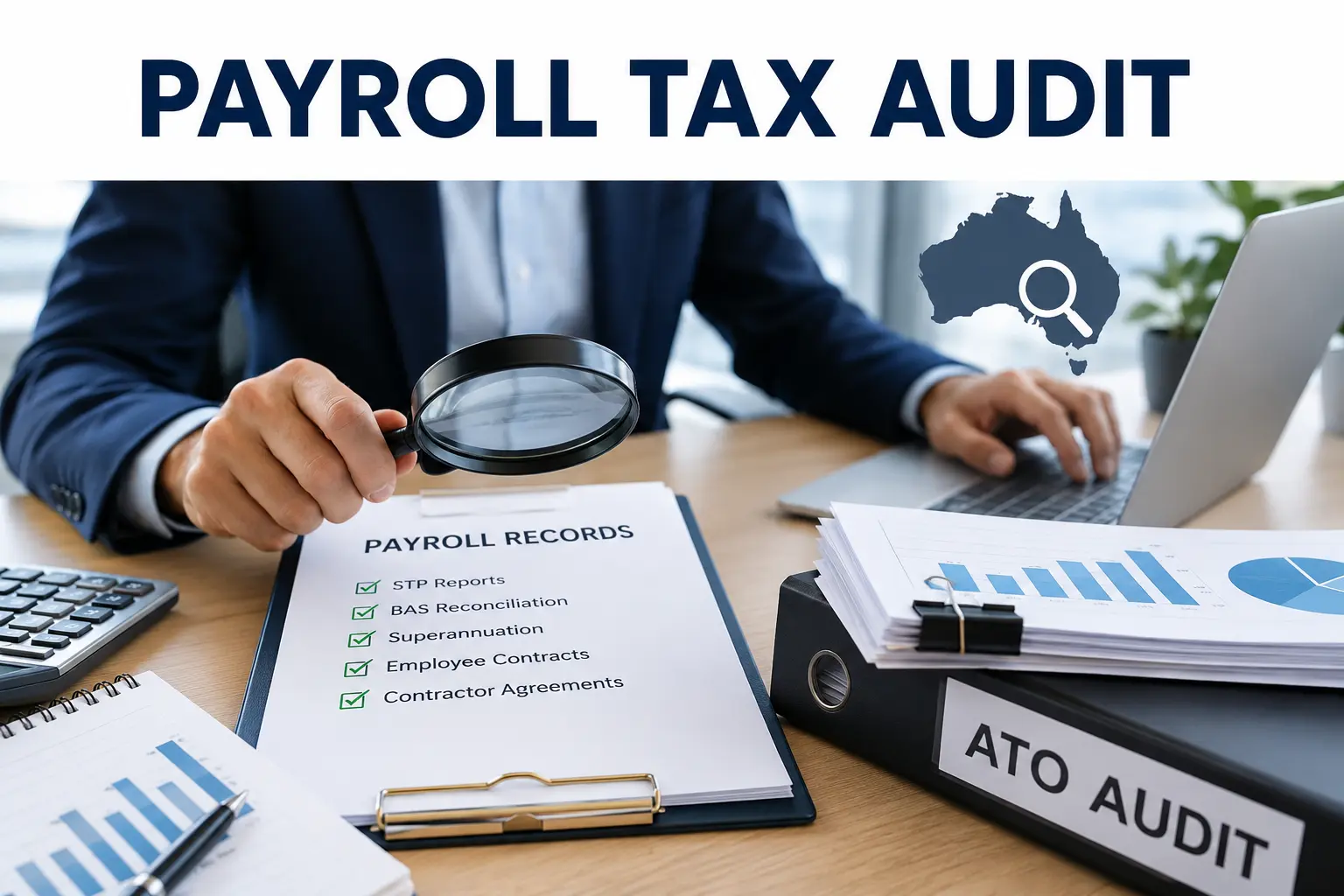
These are the records most commonly requested:
- STP Phase 2 year-to-date (YTD) reports for all pay events in the audit period
- Finalization declarations confirming all employee income statements were completed by 14 July, as required under the ATO’s STP finalization rules
- PAYG withholding reconciliation showing that BAS labels W1 (gross wages) and W2 (withholding amount) match STP totals
- Payroll registers showing individual employee pay, allowances, overtime classification, and deductions for each pay run
- Superannuation Guarantee (SG) contribution records and clearing house remittance receipts
- Employment contracts for all workers classified as employees
- Contractor agreements and ABN records for all workers engaged outside the payroll
The gap most businesses hit is the reconciliation between STP reports and BAS. Many employers lodge these through separate systems without ever confirming that the figures match at the end of each quarter. When they don’t, the ATO treats it as a discrepancy that requires explanation.
| ATO Record Request | Common Gap |
| STP YTD finalization declaration | Filed late or left in draft status |
| W1/W2 BAS reconciliation | STP and BAS were lodged from different data sources |
| Super remittance receipts | Clearing house delays are misread as on-time payment |
| Payroll register by employee | Allowances incorrectly categorized as ordinary earnings |
| Contractor ABN and agreement | Workers with ABNs but no genuine contracting arrangement |
Incomplete records don’t pause the audit. The ATO proceeds and makes assessments based on what it can see.
Why Contractor Classification Is a Separate Risk
Many businesses treat contractor classification as an HR issue. The ATO treats it as a payroll compliance issue.
Following the High Court decisions in CFMMEU v Personnel Contracting (2022), the ATO applies a whole-of-relationship test based on the actual terms of the written contract.
An ABN does not make a worker a genuine contractor. The ATO considers the legal rights and obligations in the arrangement, including whether the worker operates their own business or works as part of the engaging business.
Understanding how the contractor vs employee framework applies to your workforce is a pre-audit requirement, not an afterthought.
When the ATO finds misclassified workers, the consequences are not limited to super.
Businesses that have incorrectly classified employees as contractors face:
- Superannuation Guarantee Charge (SGC) assessed on total salary and wages, not ordinary time earnings, which produces a higher base than standard SG contributions
- Part 7 penalties under the Superannuation Guarantee (Administration) Act 1992 of up to 200% of the SGC amount
- PAYG withholding penalties for every pay period where tax was not withheld and remitted
- Fair Work Act sham contracting penalties of up to $495,000 per contravention for larger businesses
The SGC is not tax-deductible. Every dollar of SGC assessed costs the business more than the equivalent super contribution would have.
For businesses managing mixed workforces, payroll for contractors in Australia operates under different obligations than employee payroll, and those obligations need to be documented before an audit begins.
What Happens When the Records Don’t Match?
A desk audit becomes a field audit when the ATO cannot reconcile the records provided.
In a field audit, ATO officers attend the business premises or the accountant’s office and review payroll systems, employment arrangements, and financial records directly. This stage is reserved for cases where document-level review has identified inconsistencies that the ATO cannot resolve through correspondence.
The operational consequences of a failed payroll audit include:
- SGC assessments backdated to the point of misclassification, potentially covering multiple financial years
- PAYG withholding penalties applied per employee, per pay period
- Nominal interest on unpaid SGC, generally calculated at 10% per annum, plus administration fees.
- Director penalty notices where the ATO holds directors personally liable for unremitted PAYG or SGC
From 1 July 2026, the new Payday Super rules require superannuation to be paid within seven business days of each pay event. This eliminates the quarterly window businesses currently rely on to catch and correct super errors before they become audit triggers. For businesses without accurate payroll records today, accessing payroll outsourcing solutions that maintain audit-ready documentation reduces forward exposure significantly.
How Managed Payroll Reduces Audit Exposure
Audit risk is not primarily a legal problem. It is an operational one.
Records fail audits because payroll processes were not designed to produce reconcilable, complete, and time-stamped documentation across every pay cycle. A managed payroll model fixes this at the process level, connecting three workflows that are usually run separately:
- STP reporting, matched to BAS figures at the point of lodgement, not after
- Super remittance, tracked against each pay event rather than reconciled quarterly
- Worker classification, documented and reviewed before contracts are signed, not after a dispute arises
Employment contracts, payroll registers, and classification records are maintained as part of standard delivery. None of it gets compiled under pressure when an audit notice arrives.
For businesses operating across multiple states or hiring into Australia from overseas, the compliance obligations compound quickly.
Payroll services Australia operations require accurate state-level payroll tax registration, STP compliance, and super management to be running concurrently from day one. Procloz manages payroll execution for businesses operating in Australia, maintaining the records, reconciliations, and classification documentation that ATO audits specifically request.
Audit Readiness Is a Payroll Operations Problem
A payroll tax audit exposes the gaps in how payroll was run, not just how it was reported. Businesses that treat STP, super, and worker classification as separate compliance tasks tend to have the most to answer for when those records are pulled together under one review.
Structured payroll operations with reconciled records, accurate classifications, and timely super remittance are the only reliable audit defence. Payroll managed to that standard does not require last-minute document assembly when the ATO requests one.
Contact us for assistance now.
Payroll Tax Audit in Australia Frequently Asked Questions
Q1. What does the ATO look for in a payroll tax audit in Australia?
ATO checks STP vs BAS and super discrepancies, worker classification, payroll registers, and correct PAYG withholding calculation and remittance per pay cycle.
Q2. What triggers an ATO payroll audit?
Mismatches between STP data and BAS lodgements, late super payments, or contractor payrolls without PAYG withholding trigger audits via ATO data-matching.
Q3. What records does the ATO request in a payroll audit?
ATO requests STP finalizations, PAYG reconciliations, payroll registers, super receipts, employment contracts, and contractor agreements. Inconsistent records escalate.
Q4. Can contractor misclassification trigger a payroll tax audit in Australia?
Yes. Many contractors without PAYG withholding can trigger audit. Misclassification risks SGC back-assessments, penalties up to 200% of shortfall, and Fair Work Act sham contracting penalties.
Q5. How does Payday Super affect payroll audit risk from July 2026?
From 1 July 2026, super must be paid within 7 business days per pay event, removing quarterly corrections. Procloz manages timely super remittance each pay cycle.