











Last updated: July 2026
CPF changes in Singapore affect contribution rates, wage ceilings, employee deductions, employer payroll cost, CPF submissions, and payroll compliance.
For 2026, employers must apply the correct CPF rates, the S$8,000 Ordinary Wage ceiling, the Additional Wage ceiling formula, and the right employee age or Singapore Permanent Resident status.
Quick Answer: What Are the CPF Changes in Singapore?
CPF changes Singapore employers need to manage in 2026 include updated senior worker contribution rates, the S$8,000 Ordinary Wage ceiling, and correct CPF treatment for bonuses and commissions.
Payroll teams must also check employee age bands, SPR status, CPF submission deadlines, payslip deductions, and year-end employment income reporting.
These updates affect employer cost, employee take-home pay, payroll budgeting, and statutory compliance.
What Is CPF and Why Does It Matter for Payroll?
The Central Provident Fund is Singapore’s mandatory social security savings system for eligible employees.
Employers must pay CPF contributions for Singapore Citizens and Singapore Permanent Residents who meet CPF eligibility rules. The CPF Board explains these requirements in its official guidance on who should receive CPF contributions.
For payroll teams, CPF is not only a deduction.
It affects gross-to-net salary, employer statutory cost, payslips, CPF submissions, bonus payroll, employee communication, and audit readiness.
Companies setting up local payroll can also review Procloz’s guide on Singapore payroll operations setup to understand how CPF, IRAS, and MOM requirements connect.
CPF Contribution Rates in Singapore for 2026
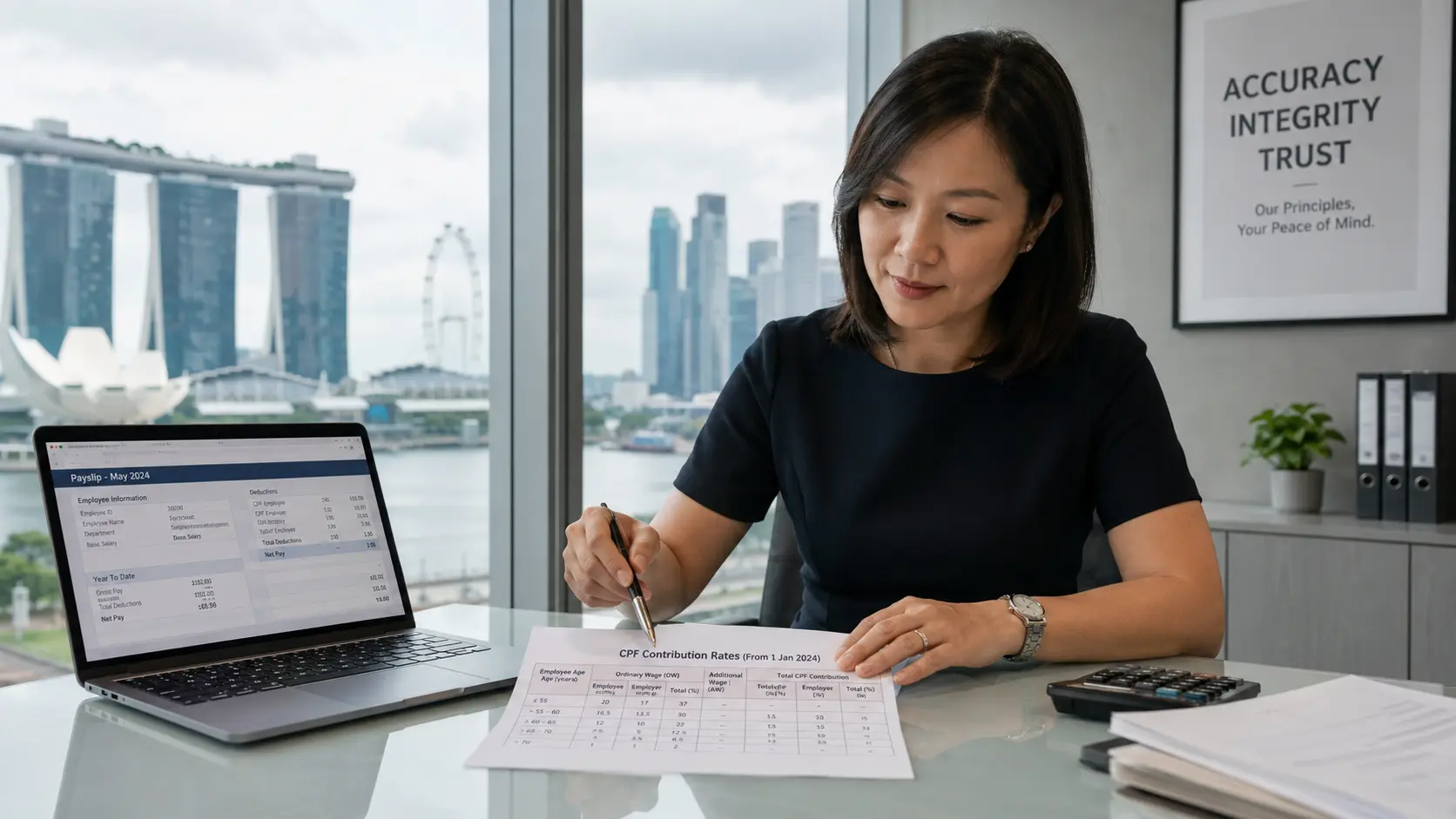
CPF contribution rates depend on the employee’s age, wage level, and citizenship or PR status.
For Singapore Citizens and SPRs from the third year onwards, employers should use the current rate tables published in the CPF Board’s guide on how much CPF contributions to pay.
| Employee age | Employer contribution | Employee contribution | Total CPF contribution | Payroll impact |
| 55 and below | 17% | 20% | 37% | Standard full-rate setup for most employees |
| Above 55 to 60 | 16% | 18% | 34% | Check age-band transition after birthday |
| Above 60 to 65 | 12.5% | 12.5% | 25% | Review senior worker deductions and employer cost |
| Above 65 to 70 | 9% | 7.5% | 16.5% | Ensure the system applies the lower age-based rate |
| Above 70 | 7.5% | 5% | 12.5% | Validate older worker payroll settings |
These rates are especially important for payroll teams managing employees close to age-band changes.
A wrong date of birth, incorrect payroll rule, or outdated rate table can lead to CPF underpayment or overpayment.
What Changed for Senior Workers in 2026?
The 2026 CPF changes are especially relevant for employees above 55 to 65.
The practical payroll risk is not only the rate change. The bigger risk is applying the wrong CPF rate after an employee crosses an age threshold.
CPF rates change based on age bands. Payroll systems must identify when an employee moves into the next CPF age group.
Employers should test age-band logic before payroll closes.
This is important for SMEs using manual payroll files and for global employers using payroll platforms configured outside Singapore.
How Does the CPF Ordinary Wage Ceiling Affect Payroll?
Ordinary Wages are wages due or granted for employment in a month and payable by the 14th of the following month.
Monthly salary is the most common example.
The Ordinary Wage ceiling limits the amount of monthly wages that attract CPF contributions. For 2026, employers should apply the S$8,000 ceiling explained in CPF Board guidance on payments that attract CPF contributions.
For example, if an employee earns S$9,000 in Ordinary Wages in a month, CPF is calculated only up to S$8,000.
Payroll should not calculate CPF on the remaining S$1,000 of Ordinary Wages.
This matters for high-earning employees, salary increments, and payroll system testing.
How Does the Additional Wage Ceiling Affect Bonuses and Commissions?
Additional Wages are wages that are not classified as Ordinary Wages.
Annual performance bonuses are a common example.
The CPF Board explains that the Additional Wage ceiling applies per employer, per calendar year. The formula is S$102,000 minus total Ordinary Wages subject to CPF for the year.
This matters during bonus payroll.
Payroll teams must track Ordinary Wages already subject to CPF before calculating CPF on bonuses, commissions, incentives, or other Additional Wages.
Finance teams should review this before year-end bonus cycles.
Late bonus checks can create CPF underpayment, overpayment, correction work, and employee queries.
Which Employees Are Affected by CPF Changes?
CPF changes affect Singapore Citizens and Singapore Permanent Residents who are eligible for CPF contributions.
For SPRs, the year of PR status matters.
Different CPF contribution rules can apply to first-year SPRs, second-year SPRs, and SPRs from the third year onwards.
Foreign employees are generally not paid CPF because CPF is for Singapore Citizens and SPRs.
However, employers should not stop at CPF when reviewing payroll obligations.
The Skills Development Levy can apply to employees working in Singapore, including foreign employees. Employers can check the CPF Board’s official page on the Skills Development Levy for the current rules.
Global companies hiring foreign employees should also review Singapore work pass requirements.
Procloz’s Singapore work pass guide explains how MOM rules, pass categories, salary requirements, and payroll data can connect.
How CPF Changes Affect Employer Cost and Employee Take-Home Pay
CPF changes can affect payroll in two directions.
Employer CPF contributions increase statutory employment cost. Employee CPF deductions reduce take-home pay but increase CPF savings.
This is why HR and finance teams should not treat CPF updates as only a back-end payroll task.
Employees may notice lower net pay after a rate change or payroll correction.
A short explanation in employee communication can reduce confusion and payroll queries.
For SMEs, CPF changes are also a budgeting issue.
Higher employer CPF cost can affect hiring budgets, bonus planning, and monthly cash flow.
CPF Payroll Readiness Checklist for Employers
CPF changes should be handled as a payroll control project.
A simple checklist helps payroll teams confirm that the system, employee records, and approval process are ready before payroll closes.
| Payroll area | What to check | Why it matters |
| CPF rate table | Confirm 2026 CPF rates are active | Prevents underpayment or overpayment |
| Employee age band | Check DOB and age transition logic | Applies the correct rate after birthdays |
| Citizenship or SPR status | Validate Singapore Citizen, SPR, or foreign status | Determines CPF eligibility |
| SPR year | Confirm first year, second year, or third year onwards | SPR contribution treatment can differ |
| Ordinary Wage ceiling | Cap OW at S$8,000 in 2026 | Avoids excess CPF calculation |
| Additional Wage ceiling | Apply the annual AW formula correctly | Prevents bonus payroll errors |
| CPF submission file | Test CPF EZPay or payroll output | Reduces submission issues |
| Payslip output | Show CPF deductions clearly | Helps employees understand net pay |
| IRAS data | Reconcile salary, bonus, and deductions | Supports year-end reporting |
| Audit trail | Keep approvals and change logs | Supports compliance review |
Companies managing CPF manually should review their process before salary or bonus payroll.
For businesses that want external support, Procloz provides outsourced payroll services Singapore to help manage CPF, IRAS, MOM, payslip, and year-end payroll requirements.
CPF Submission Deadlines and Late Payment Risk
CPF contributions are due by the last day of the calendar month.
The CPF Board explains late payment rules in its guidance on enforcement and penalties for non-compliance.
Employers should not wait until the deadline to identify wage, rate, or file issues.
CPF should be part of the monthly payroll close calendar.
Payroll teams should confirm CPF amounts, employee records, submission files, and payment approvals before month-end.
How CPF Changes Connect With IRAS Year-End Reporting
CPF and IRAS reporting are separate obligations, but the data overlaps.
Payroll teams use salary, bonus, CPF deduction, and employee records for both monthly payroll and year-end employment income reporting.
IRAS requires AIS employers to submit employment income information electronically each year. Employers can check the official IRAS guidance on submitting employment income records under AIS.
This is why CPF changes should not be reviewed only inside the monthly payroll run.
They should also be reconciled before IR8A and AIS submission.
Common CPF Payroll Mistakes Employers Should Avoid
The most common CPF payroll mistakes are usually system and employee record issues.
They happen when payroll data changes but the payroll setup does not.
Employers should watch for these risks:
- Applying the wrong age band after an employee birthday
- Missing a change from foreign employee to SPR
- Using the wrong SPR year rate
- Treating bonuses as Ordinary Wages
- Forgetting the S$8,000 Ordinary Wage ceiling
- Miscalculating the Additional Wage ceiling
- Paying CPF late after payroll close
- Not reconciling CPF data before IRAS AIS submission
- Not keeping approvals for manual payroll changes
Singapore payroll also sits within wider employment compliance.
Procloz’s guide to the Singapore Employment Act can help employers connect payroll controls with salary payment practices, working hours, payslips, and employment records.
How Singapore SMEs and Global Employers Should Prepare
Singapore SMEs should treat CPF changes as a recurring payroll governance task.
A smaller team may not have a dedicated payroll compliance specialist, so documentation matters.
Keep a simple monthly checklist.
Confirm rate tables, CPF ceilings, employee status, submissions, and approval records before every payroll close.
Global employers hiring in Singapore need a different level of control.
They must ensure global payroll systems reflect local CPF rules instead of applying a generic deduction model.
A Singapore employee cannot be processed like an employee in the United States, Australia, or New Zealand.
Each country has different tax, contribution, reporting, and employment rules.
Procloz’s global payroll services help companies manage payroll across countries while keeping local compliance requirements visible.
When Should Employers Review Their Singapore Payroll Setup?
Review your Singapore payroll setup before the first 2026 payroll run, before bonus season, and before year-end reporting.
You should also review payroll when an employee becomes an SPR, crosses an age band, receives a large bonus, changes pay structure, or moves into a new employment category.
A review is also useful when headcount grows.
More employees create more CPF records, more pay variables, and more approval points.
Talk to Procloz if you need help reviewing CPF-ready payroll operations for Singapore employees.
Frequently Asked Questions on CPF Changes Singapore
What are the CPF changes in Singapore for 2026?
CPF changes Singapore employers need to manage in 2026 include current CPF contribution rates, the S$8,000 Ordinary Wage ceiling, and the correct Additional Wage ceiling formula. Payroll teams must also review employee age bands, SPR status, CPF deadlines, and year-end reporting data.
How do CPF changes affect payroll processing?
CPF changes affect payroll by changing employer contributions, employee deductions, wage ceiling calculations, bonus treatment, payslip outputs, and CPF submission checks. Employers must update payroll systems before processing salary or bonus payroll and reconcile CPF data before year-end employment income reporting.
Who must receive CPF contributions in Singapore?
Employers must pay CPF contributions for eligible Singapore Citizens and Singapore Permanent Residents. Foreign employees are generally not paid CPF. However, other payroll obligations may still apply, so employers should review CPF, SDL, tax reporting, work pass, and employment record requirements together.
What is the CPF Ordinary Wage ceiling in 2026?
The CPF Ordinary Wage ceiling in 2026 is S$8,000. This means CPF contributions on monthly Ordinary Wages are calculated only up to S$8,000. If an employee earns S$9,000 in Ordinary Wages for a month, CPF is not required on the extra S$1,000.
When must employers submit CPF contributions?
CPF contributions are due by the last day of the calendar month. Employers should complete CPF checks before month-end so rate errors, employee record issues, and payment approvals do not delay submission. Late CPF payment can result in interest and enforcement action.