












Last updated: May 2026
73% of HR leaders expect more than half of all new hires to be based outside their primary country by 2026, yet 74% of those already hiring internationally have faced compliance challenges in a new market, with 31% of those incidents costing over USD 50,000 (Remote Global Workforce Report, 2025). International remote teams are now the norm, not the exception. The challenge is not whether to build one it is how to do it without the compliance, payroll, and cultural mistakes that slow most companies down.
How Big Is the International Remote Work Shift in 2026?
Remote and hybrid work now accounts for approximately 40% of the global workforce (Girl Power Talk / Pew Research, 2025). Over 48% of businesses with more than 500 employees already hire across three or more countries (JobsPikr, 2026). The shift is structural, not cyclical.
Employers who hire remotely across borders access talent pools that are 340% larger than domestic hiring alone (Second Talent, 2026). The operational upside is real. So are the risks if compliance, payroll, and team management are not handled correctly from day one.
What Are the Key Challenges of Building an International Remote Team?
1. Legal and Regulatory Compliance Across Multiple Jurisdictions
The most costly challenge in international remote hiring is compliance. Labour law applies where the employee is based, not where the employer is registered. That means every new country adds a new set of employment contracts, statutory benefits, termination rules, tax obligations, and worker classification requirements.
74% of companies hiring internationally have faced compliance incidents, with nearly a third costing over USD 50,000 each (Remote Global Workforce Report, 2025). The most common triggers are misclassified contractors, incorrectly structured employment contracts, and missed statutory filing deadlines.
The practical solution for most businesses particularly those entering a new market for the first time or with small headcounts, is a global Employer of Record service. An EOR acts as the legal employer in each country, managing contracts, statutory benefits, tax filings, and compliance on your behalf. This eliminates the need to set up a local entity (which typically costs USD 15,000 to 50,000+ and takes three to six months) before the first hire lands.
Key compliance areas that require country-specific attention:
| Compliance Area | What Varies by Country |
|---|---|
| Employment contracts | Fixed vs. open-ended terms, mandatory clauses, language requirements |
| Termination rules | Notice periods, severance entitlements, and procedural requirements |
| Statutory benefits | Leave entitlements, pension/provident fund contributions, and health cover |
| Worker classification | Contractor vs. employee thresholds vary significantly across APAC, EU, and the Americas |
| Data protection | GDPR, Australia’s Privacy Act, Singapore’s PDPA, India’s DPDP Act |
| Tax and social security | Employer contribution rates differ in every jurisdiction |
Procloz’s in-country expertise covers employment law compliance across key markets, including Australia, Singapore, India, the Philippines, New Zealand, and the US.
2. Global Payroll Complexity
Paying a distributed international team accurately and on time is operationally harder than most businesses anticipate. Each country has its own pay cycle requirements, minimum wage obligations, tax withholding rules, statutory deduction rates, and currency considerations.
Managing this manually across even three countries introduces significant error risk. 49% of workers who experience a payroll error leave within the year (ADP, cited via multiple workforce reports). The financial and reputational cost of payroll errors in international teams compounds quickly.
The right approach depends on headcount and market spread:
| Headcount in Market | Recommended Payroll Model |
|---|---|
| Under 10 employees, single country | EOR-managed payroll fastest, most compliant |
| 10–100 employees, single country | In-country payroll provider with local expertise |
| Multi-country, any headcount | Aggregated global payroll via a specialist provider with in-country partners |
| Contractors across countries | Dedicated contractor payment solution with classification management |
Procloz’s global payroll services handle payroll execution, statutory filings, and multi-currency payments across all key markets, including outsourced payroll services in Australia, payroll services in Singapore, payroll services in the Philippines, and payroll services in New Zealand.
3. Contractor Misclassification Risk
Many businesses entering new markets start with contractors faster to onboard, have lower fixed costs, more flexible. The compliance risk is significant. Misclassifying a worker who should legally be an employee triggers back-taxes, penalties, and in some jurisdictions, mandatory reinstatement.
The rules differ materially by country. What qualifies as an independent contractor relationship in the US does not automatically qualify in Australia, India, or the UK. Each jurisdiction has its own tests based on control, economic dependence, exclusivity, and integration, and enforcement has increased across APAC and Europe since 2024.
27.7% of companies cite entity setup cost as the top barrier to international expansion (Remote Global Workforce Report, 2025). The instinct is to use contractors to avoid that cost. The risk is that doing so incorrectly creates a larger liability than the entity would have incurred. Procloz’s contractor management service handles compliant classification, onboarding, and payment across 50+ countries.
4. Time Zone and Communication Coordination
Remote international teams span multiple time zones by definition. Without deliberate structure, this creates asynchronous bottlenecks, delayed decisions, and uneven workloads, with employees at the edges of the time zone range consistently asked to work outside standard hours.
Harvard Business School research confirms that time zone differences measurably increase after-hours load, with impact varying by team size and geography (Harvard Business School Working Knowledge, 2024). The resolution is not scheduling more meetings; it is fewer, better-structured ones, with clear async documentation protocols in between.
Practical fixes that work:
- Identify a shared overlap window of two to three hours across all time zones and protect it for synchronous decisions.
- Use written-first communication for everything that does not require real-time input decisions, updates, and context-setting, as all work better in writing across time zones.
- Rotate meeting times across quarters so no single region consistently takes unsociable hours.
- Document all decisions in a shared system immediately after meetings; distributed teams cannot rely on corridor context.
5. Cultural and Language Differences
APAC alone spans markets with fundamentally different workplace cultures, communication norms, and management expectations. What reads as direct feedback in Australia reads as confrontational in Japan. Hierarchical deference in parts of Southeast Asia can suppress the candid input that flat management structures depend on.
64% of HR leaders expect the majority of routine HR tasks to be automated by 2026 (Remote Global Workforce Report, 2025), but cultural intelligence cannot be automated. It requires deliberate investment in manager capability, onboarding that addresses cultural context explicitly, and team structures that account for communication-style differences.
The practical approach:
- Brief every manager on the specific cultural norms of the markets they are managing before the team goes live, not after.
- Standardise onboarding materials across markets, but localise communication style guidance for each country.
- Establish explicit norms around feedback, disagreement, and escalation, and document them so new joiners across all markets are aligned from day one.
6. Data Security and Cross-Border Privacy Obligations
International remote teams process payroll data, employment records, and in many cases, client data across multiple jurisdictions simultaneously. Each country has its own data protection framework, and non-compliance with any of them carries financial penalties.
The key frameworks affecting APAC-based remote teams in 2026: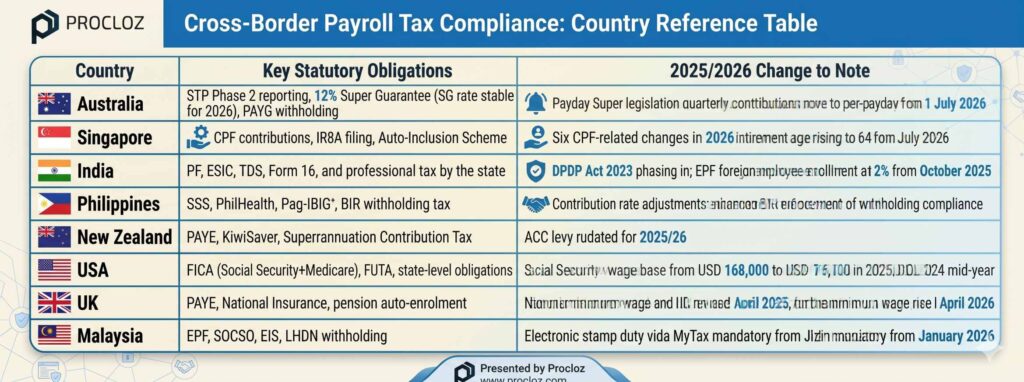
Handling employee data across these jurisdictions via spreadsheets or shared drives creates direct exposure. Purpose-built payroll and HR platforms with role-based access controls, encryption, and audit trails are the minimum viable infrastructure for a multi-country remote team. Procloz holds ISO 27001 and ISO 9001 certifications. See the full registrations and accreditations page for details.
7. Competitive Compensation Across Markets
Remote international teams require compensation structures that are locally competitive, internally equitable, and legally compliant simultaneously. 82% of HR leaders report more pressure on pay due to cost-of-living increases, while 77% believe pay transparency will improve culture (Remote Global Workforce Report, 2025).
Location-based pay remains the most common model, with salaries benchmarked to the market where the employee is located. This keeps costs manageable while remaining competitive locally. The challenge arises when team members in different markets discover pay disparities for equivalent roles, which is increasingly likely as pay transparency laws expand globally.
Procloz’s compensation and benefits advisory helps businesses benchmark packages by market, structure compliant benefit plans, and build transparency-ready compensation frameworks before regulations mandate it.
How Does an Employer of Record Solve These Challenges?
An EOR is the fastest and most compliant way to hire internationally without establishing a legal entity in each country. It addresses six of the seven challenges above directly:
| Challenge | How EOR Resolves It |
|---|---|
| Legal and regulatory compliance | EOR is the legal employer; it carries all employment law compliance obligations |
| Payroll complexity | EOR manages payroll, tax withholding, and statutory filings per market |
| Contractor misclassification | EOR converts risk by employing workers directly on compliant contracts |
| Data security | EOR platforms operate to certified data security standards |
| Compensation structure | EOR provides locally benchmarked contracts and statutory benefit packages |
| Entity setup cost | EOR eliminates the entity requirement entirely for early-stage market entry |
73% of HR leaders at companies using EOR models report faster market entry timelines compared to entity-based expansion (Remote Global Workforce Report, 2025). Procloz’s global EOR services cover entity-free hiring across 100+ countries, with in-country compliance teams in each key market.
Frequently Asked Questions on Building an International Remote Team in 2026:
What is the most common compliance mistake when building an international remote team?
Contractor misclassification. Businesses entering new markets often onboard workers as independent contractors to avoid entity setup costs, without verifying that the working arrangement meets the local legal definition of a contractor. When it does not, the company owes back taxes, penalties, and sometimes statutory benefits from the original start date. 74% of companies hiring internationally have already faced a compliance incident costing over USD 50,000 (Remote, 2025). Using an EOR or a dedicated contractor management service eliminates this risk.
How do you pay international remote employees compliantly across multiple countries?
The recommended model for multi-country teams is an aggregated global payroll provider working with in-country partners in each market. This approach handles local pay cycle requirements, statutory deduction rates, tax filings, and currency conversion without requiring a local payroll team in every country. For smaller headcounts or early-stage market entry, an EOR-managed payroll arrangement is faster and lower-risk. Procloz’s global payroll services operate across both models.
What is the fastest way to hire an employee in a new country without setting up a legal entity?
An Employer of Record. An EOR allows a business to hire legally in a new country within days. The EOR is the legal employer, handling all employment contracts, payroll, tax, and compliance obligations locally. This removes entity setup costs of USD 15,000 to 50,000+ per market and compresses the timeline from months to days. Procloz’s global EOR services cover 100+ countries with in-country legal and payroll expertise in each.